His visit comes ahead of the upcoming official trip of Indian Army chief Gen M M Naravane to Nepal in the first week of November. Goel called on Prime Minister Oli at his official residence at Baluwatar on Wednesday evening, the premier's press advisor Surya Thapa told PTI.

India should engage the world on the basis of its confidence in its identity rather than trying to please the global community as their "pale imitation", External Affairs Minister S Jaishankar said on Wednesday amid increasing Western pressure on the country to oppose the Russian invasion of Ukraine.
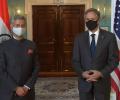
Blinken is scheduled to arrive in New Delhi late on July 27. He is scheduled to attend a full slate of engagements on July 28. During his stay in the country, he will meet Prime Minister Narendra Modi and External Affairs Minister S Jaishankar.
On India's entry into the NSG, he said, "We have said many times this is a multilateral issue."

Union Finance Minister Pranab Mukherjee met United States Secretary of State Hillary Clinton and National Security Adviser Tom Donilon to discuss bilateral and regional issues.
China's surplus foreign exchange reserves and India's long-term fund requirement complement each other.

Biden has reiterated America's support for India's permanent membership on a reformed UNSC and its entry into the NSG during his first in-person bilateral meeting with Modi at the White House.

Pakistan's close ties with China and its lack of democracy and disregard for human rights will not be overlooked, said Haqqani, who currently is a Senior Fellow at the Hudson Institute think-tank in Washington.

In addition to the attack helicopters, the contract also includes fire control radars; Hellfire Longbow missiles; stinger Block I-92H missiles; night vision sensors and inertial navigation systems.

The US, in coordination with allies and partners, continued to forcefully respond to Russia's "unjustified, unprovoked and premeditated" invasion of Ukraine by imposing sanctions on Putin and Lavrov.

It also comes ahead of a possible visit by President Donald Trump to India later this month. Trump is set to visit India on a two-day trip between February 23 and 26 and both sides are in the process of fine-tuning his schedule, according to sources in New Delhi.

Secretary of State John Kerry arrived in New Delhi onto participate in the fourth round of Indo-US strategic dialogue even as US announced to invest $100 million in India's burgeoning clean energy sector.

'Of all the areas that define the future for a strong US-India partnership, none is more important than our defence and security ties.'
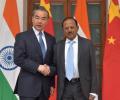
The two sides have already held 21 rounds of talks under the framework of SR dialogue which was set up to find an early solution to the border dispute.

Setting aside the recent tumult in relations caused by the Khobragade episode, US Deputy Secretary of State Heather Higginbottom attended the first major event India's new Ambassador Dr S Jaishankar hosted in Washington. Rediff.com's Aziz Haniffa reports from the Republic Day celebration in the US capital.

Seeking to seize "transformative moment" in ties with India, US Secretary of State John Kerry will arrive in New Delhi on Wednesday for talks on key issues with the new Indian leadership.

After his wide-ranging talks with Modi on the second and final day of his India visit, Johnson said the new defence and security partnership will enable India to strengthen its domestic defence industry as well as help the two countries protect vital shared interests in the Indo-Pacific.

In the test, a space rocket boosted a hypersonic glide vehicle, one capable of carrying a nuclear device, which circled the globe before impacting.

'The pressure to work together is even greater than before, because the Chinese have launched a full-court press on the border, in the region, and globally to advance their geopolitical agenda.'

India is monitoring the situation very closely and will see how it develops in the next few days.

The talks will focus on 'delimitation of the border, boundary management and a host of bilateral and international issues'.

The 792-room luxury five-star hotel has been mentioned as a possible venue for the talks as it has held major conferences over the years.

However, there will be no bilateral meetings between Swaraj, Sitharaman with their Pakistani counterparts.

PM Modi said that all countries should wipe out all terror havens.
As US President Joe Biden launched a new trade deal with 12 Indo-Pacific nations, including India, to enhance trade, economic and investment opportunities, China, which sees the pact as a threat to its dominance in the region, went on the offensive against it, promising more opening up, while the official media here termed it as "economic Nato".

The US said that it supports dialogue between India and Pakistan over Kashmir.
PM Modi also called for a strong action plan for combating extremism.

It would be realistic to see India's position on the DGMOs joint statement more as 'engagement, different from dialogue', where our subsequent options could be decided depending on the realities of the situation on the ground, notes Rana Banerji, who headed the Pakistan desk at the Research and Analysis Wing, India's external intelligence agency.
South Korean President Park Geun-hye's visit to India will enhance economic and military ties between the two countries and give the relationship a strategic dimension, says Jiye Kim.

Britain has finalised 1 billion pounds worth of new trade and investment with India, creating over 6,500 jobs in the UK, to be signed off at a virtual summit between Prime Minister Boris Johnson and his Indian counterpart Narendra Modi on Tuesday. The investments confirmed by Downing Street on Monday evening form part of an Enhanced Trade Partnership (ETP), which will set the ambition to double the value of UK-India trade by 2030 and declare a shared intent to begin work towards a comprehensive Free Trade Agreement (FTA). "Like every aspect of the UK-India relationship, the economic links between our countries make our people stronger and safer," Johnson said.

Sweden's backing to India was conveyed to President Pranab Mukherjee, who is in Stockholm on a state visit.
'Singh apprised the Japanese leaders about Islamabad's 'evil design' on Kashmir at a time when Pakistan has decided to internationalise the issue.'
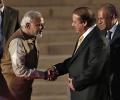
Pakistan PM Nawaz Sharif may meet PM Narendra Modi in Washington on the sidelines of the Nuclear Security Summit, a top aide to Pakistan Premier said on Tuesday.

Key to China's decision regarding Taiwan will be its leadership's assessment whether the US will come to Taiwan's defence, explains Jayadeva Ranade, the former senior RA&W officer and China expert.

'Nasr' is a high-precision weapon system with the ability to be deployed quickly, the army said.
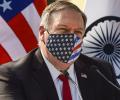
Severely critical of China, Pompeo, cited killing of Indian Army personnel in the Galwan Valley in eastern Ladakh in a clash with the Chinese military, and asserted that both India and the US are taking steps to strengthen cooperation against all threats and not just those posed by the Chinese Communist Party.
The official told the reporters during a conference call on Friday, ahead of the next week's 2+2 India-US Ministerial in New Delhi, that the Trump administration was providing support to India through defence sales, joint military exercises and information sharing.

As China's ruling CPC appointed 'fifth generation' leaders headed by Xi Jinping, high-level Sino-India contacts are set to resume this month starting with the Strategic Economic Dialogue, which would be followed by a likely visit of National Security Advisor Shivshankar Menon in Beijing.
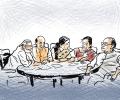
Rediff.com's Dominic Xavier introduces you to the new look CCS, the most elite club in government.

United States Secretary of State Antony Blinken during his maiden trip to India next week would meet Prime Minister Narendra Modi and External Affairs Minister S Jaishankar to discuss wide range of bilateral, regional and global issues, his spokesperson said on Friday.
